
The technologies, in plain language
Every category this observatory tracks, explained for a reader meeting the subject for the first time: what each technology is, how it works, what it records, and where you would encounter it. Counts are deployments on the public record across the covered jurisdictions.
ALPR 4,182 Fixed cameras & RTCC 357 Face recognition 1,000 Drones / UAS 1,840 Gunshot detection 248 Body-worn & dashcam 5,486 Doorbell & camera registry 758 Cell-site simulators 84 Predictive policing 201 Social-media monitoring 0 Fusion & investigative platforms 1,062
“Surveillance technology” here means systems a government body operates that observe, record, or identify people and vehicles. Seven categories are core: imaging and sensor systems pointed at public space. Four are adjacent: analytic or communications tools tracked in the record but outside the sensing core. A count is deployments on the public record, one entry per agency and technology; a zero means none on record, not necessarily none in operation.
Automated license-plate readers
4,182 on record
- What it is
- Cameras that photograph passing vehicles and automatically read the plate in each image, attaching a time and location to every read.
- How it works
- Fixed cameras on poles and intersections, or mobile units on patrol cars, capture plates continuously. Software extracts the plate number and checks it against “hot lists” such as stolen vehicles or wanted persons; every read, matched or not, is stored in a searchable database.
- What it records
- The plate number, a photo, a timestamp, and a location, for every vehicle that passes, not only vehicles under suspicion. How long reads are kept varies by agency policy, from days to years.
- Where you'd encounter it
- Intersections, highway on-ramps, parking-lot entrances, and patrol-car roofs. Neighborhood associations and businesses operate them too, and some agencies can search those private networks.
45% support (17% strongly, 28% somewhat); 33% oppose (20% strongly, 13% somewhat); 21% not sure (YouGov US, 2025, US). Asked: “Would you support or oppose the use of automated license plate readers using computer-controlled cameras for law enforcement purposes in your community?”
Fixed cameras & real-time crime centers
357 on record
- What it is
- Agency-operated video cameras in public places, and the real-time crime centers (RTCCs), control rooms where many feeds are watched together, live.
- How it works
- Feeds from agency cameras, and often from registered private or partner cameras, route to monitoring software. An RTCC pairs live video with maps and databases, and increasingly with analytics such as object or vehicle detection.
- What it records
- Continuous video of the covered public space. Retention and who may view footage are set by each agency's policy.
- Where you'd encounter it
- Downtown cores, transit stations, parks, and public housing. The RTCC itself is a facility. What you see on the street is the camera.
40% more comfortable; 41% makes no difference; 13% more uncomfortable; 6% don't know (YouGov GB, 2024, UK). Asked: “Does the presence of visible CCTV cameras make you more comfortable or more uncomfortable?”
San Francisco, California, 2024: Proposition E (San Francisco, March 2024) (Ballot Simplification Committee digest: a yes vote authorized the SFPD to install surveillance cameras in public spaces without Police Commission or Board of Supervisors approval, including cameras equipped with facial recognition technology.) passed: 54.09% yes (120,529 votes) to 45.91% no (102,288 votes).
Face recognition
1,000 on record
- What it is
- Software that compares a face in an image or video against a database of known faces to suggest an identity.
- How it works
- The software measures a face into a numeric template and searches reference databases (commonly mugshots, in some jurisdictions driver's-license photos) returning ranked candidates with confidence scores. Most published agency policies treat a match as an investigative lead rather than an identification.
- What it records
- Face templates and search history. The reference database matters as much as the camera: it defines who can be looked up at all. Independent testing (the US National Institute of Standards and Technology's vendor tests) has measured accuracy varying across algorithms and demographic groups.
- Where you'd encounter it
- Usually nowhere visible. Most use runs after the fact on existing footage or photos. A small number of forces, mostly in the United Kingdom, announce live deployments in public places, typically from marked vans.
46% good idea for society; 27% bad idea for society; 27% not sure (Pew Research Center, 2022, US). Asked: “Facial recognition technology can identify someone by scanning their face in photos, videos or in real time. This technology could be used by police to look for people who may have committed a crime or monitor crowds in public spaces. Do you think the widespread use of facial recognition technology by police would be a… Good idea for society / Bad idea for society / Not sure”
At public protests: 61% acceptable, 38% not acceptable. Entering large events like concerts: 63% acceptable, 36% not acceptable. As they walk down the street: 31% acceptable, 68% not acceptable (Pew Research Center, 2022, US). Asked: “Would you consider each of the following uses of facial recognition technology by police to be acceptable or not acceptable? Scanning people … At public protests / As they enter large events like concerts to see who is in the crowd / As they walk down the street”
48% agree the police use of facial recognition is currently controlled to a necessary or appropriate level; 38% neither agree nor disagree (ICO/Revealing Reality, 2025, UK). Asked: “To what extent do you agree or disagree with the following statement - 'I think the use of facial recognition technology by the police in the UK is currently controlled using rules/regulations to a necessary or appropriate level'”
59% support (23% strongly, 36% somewhat); 29% oppose (15% somewhat, 14% strongly); 12% don't know (YouGov GB, 2026, UK). Asked: “Do you support or oppose allowing police to use live facial recognition technology in public spaces?”
Bellingham, Washington, 2021: Initiative No. 2021-02 (Bellingham) (Barred the City of Bellingham from acquiring or using facial recognition technology or predictive policing technology, including via a third-party contractor acting on the city's behalf, and barred retention or court use of data acquired in violation of the ban.) passed: 57.2% yes (16,630 votes) to 42.8% no (12,445 votes).
Drones / UAS
1,840 on record
- What it is
- Uncrewed aircraft an agency flies for overhead observation, imaging, or sensing.
- How it works
- Flown by a remote pilot or a programmed route, carrying video, zoom, and often thermal cameras. “Drone-as-first-responder” programs launch automatically toward 911 calls to stream video before officers arrive.
- What it records
- Aerial video and imagery of whatever is below (including people and property not related to the call), plus flight logs of where the aircraft went.
- Where you'd encounter it
- Over crime scenes, searches, public events, and disaster areas. The aircraft are small and often go unnoticed from the ground.
59% favor (15% strongly, 44% somewhat); 41% oppose (Cato Institute/YouGov, 2016, US). Asked: “Do you favor or oppose allowing police forces inside the United States to regularly use unmanned aircraft called 'drones' to assist in their police work?”
No qualifying national survey has asked about this technology since 2016; the finding above is the most recent on record, not a current measurement.
San Francisco, California, 2024: Proposition E (San Francisco, March 2024) (Ballot Simplification Committee digest: a yes vote authorized the SFPD to use drones without Police Commission or Board of Supervisors approval, including drones equipped with facial recognition technology.) passed: 54.09% yes (120,529 votes) to 45.91% no (102,288 votes).
Gunshot detection
248 on record
- What it is
- Networks of acoustic sensors that detect and locate suspected gunfire and alert the agency.
- How it works
- Microphones mounted on rooftops and poles triangulate loud impulsive sounds; software (with human review at the vendor, in the most common systems) classifies the sound and sends dispatchers a location within roughly a city block.
- What it records
- The acoustic triggers and, in most systems, short audio snippets around each suspected shot. Sensor locations are generally not disclosed.
- Where you'd encounter it
- Mounted high in covered neighborhoods, typically unmarked and not visible from the street.
No independent national polling on this technology is on record for the countries WatchWatch covers.
Body-worn & dash cameras
5,486 on record
- What it is
- Cameras worn by officers or mounted in vehicles that record encounters with the public.
- How it works
- Recording starts manually or by trigger, a holster draw or the light bar, and footage uploads to an evidence-management system, most commonly a vendor cloud platform.
- What it records
- Video and audio of stops, calls, and arrests, including inside homes. Whether and when the public can see footage varies widely by jurisdiction and policy.
- Where you'd encounter it
- On an officer's chest and in patrol vehicles, the one category here you will most often see directly.
89% favor (53% strongly, 35% somewhat); 11% oppose (Cato Institute/YouGov, 2016, US). Asked: “Do you favor or oppose requiring police officers to wear body cameras that would record video of their interactions?”
No qualifying national survey has asked about this technology since 2016; the finding above is the most recent on record, not a current measurement.
Doorbell & camera registry programs
758 on record
- What it is
- Programs that give an agency access to privately owned cameras: doorbell-camera partnerships, resident camera registries, and platforms that integrate private feeds.
- How it works
- Residents and businesses register their cameras or join a sharing platform; the agency requests footage, or, on some integration platforms, views feeds directly, under the program's terms.
- What it records
- Whatever the private cameras see. The program's reach is the map of participating cameras, which is usually not published.
- Where you'd encounter it
- Doorbells and home or business security cameras in participating neighborhoods, indistinguishable from cameras that don't share.
No independent national polling on this technology is on record for the countries WatchWatch covers.
Cell-site simulators
adjacent 84 on record
- What it is
- Devices that imitate cell towers so nearby phones connect to them, often called Stingrays or IMSI catchers.
- How it works
- A phone identifies itself to the strongest nearby “tower.” The simulator logs those identifiers and can locate a phone precisely; units are vehicle-mounted or portable.
- What it records
- Identifiers and signal data from every phone in range, not only a target's. Use is typically governed by warrant requirements and non-disclosure terms that vary by jurisdiction.
- Where you'd encounter it
- By design, you wouldn't. The device presents itself to your phone as an ordinary tower.
No independent national polling on this technology is on record for the countries WatchWatch covers.
Predictive policing
adjacent 201 on record
- What it is
- Software that forecasts where crime may occur, or who may be involved, to direct patrols and attention.
- How it works
- Models trained on historical crime and arrest data score places or people; the scores feed patrol assignments or intervention lists.
- What it records
- It senses nothing itself. It consumes records the agency already holds, and its outputs (heat maps, scores) become new operational records.
- Where you'd encounter it
- Not on the street at all; it runs inside the agency's software. Its footprint is visible only in where patrols go.
No independent national polling on this technology is on record for the countries WatchWatch covers.
Bellingham, Washington, 2021: Initiative No. 2021-02 (Bellingham) (Barred the City of Bellingham from acquiring or using facial recognition technology or predictive policing technology, including via a third-party contractor acting on the city's behalf, and barred retention or court use of data acquired in violation of the ban.) passed: 57.2% yes (16,630 votes) to 42.8% no (12,445 votes).
Fusion & investigative platforms
adjacent 1,062 on record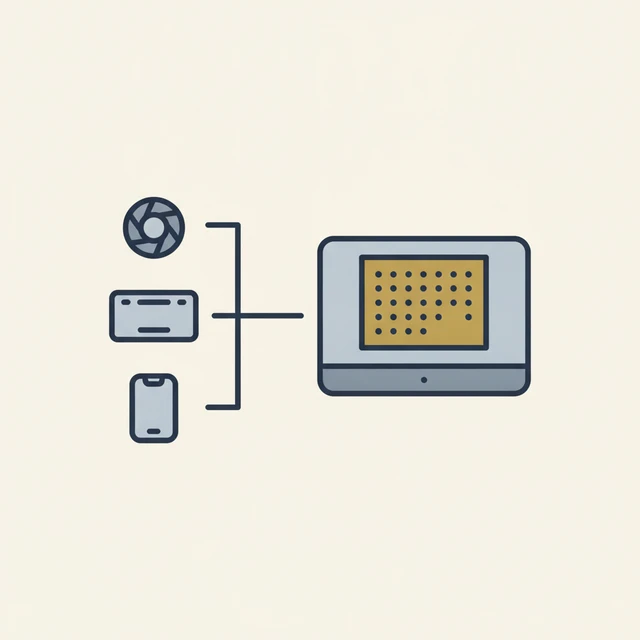
- What it is
- Third-party software that pulls together data from multiple sources, sometimes including other surveillance feeds a government body already collects, for law-enforcement search and analysis. A vendor sells or licenses access; the government does not build the platform itself.
- How it works
- An agency queries the platform's own interface rather than a single sensor. Some platforms index data the agency already collects, such as license-plate reads; others add commercial or public records the agency did not gather on its own. Some are built to share data among multiple agencies, including across state lines.
- What it records
- It senses nothing itself. Its record is whatever data sources feed into it, indexed and made searchable, plus the queries agencies run against it.
- Where you'd encounter it
- Not on the street. It runs inside an agency's software, reached through the same public-records process that covers any other database.
No independent national polling on this technology is on record for the countries WatchWatch covers.
The questions the oversight layer asks
Every one of these technologies raises the same short list of questions, and answering them per agency is this observatory's next layer of the record: Is there a published use policy? How long is data kept? Who is it shared with? Can the public reach the footage or data, and through what process? What law governs the technology here? Where a jurisdiction's records have not yet been requested, its status reads not yet requested, a status and not a verdict.
Where these counts come from
Each count is deployments on the public record: one entry per agency and technology, with its citations kept. Sources, reconciliation, and what the data is and is not are on the methodology page; the arguments people make about these tools, for and against, are mapped on the perspectives page.
Social-media monitoring
adjacent 0 on recordNo independent national polling on this technology is on record for the countries WatchWatch covers.